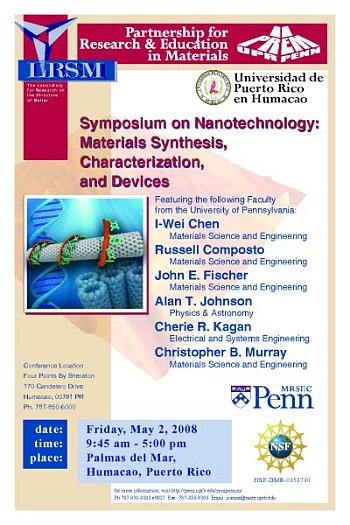
The Symposium ...
The Symposium was held on May 2, 2008 at Palmas del Mar, Humacao, Puerto Rico.
Featuring the following Faculty from the University of Pennsylvannia
 | I-Wei Chen, Materials Science and Engineering, has made important contributions to the field of ceramics research. He is currently working in the nanotechnology of ferroelectrics, thin film devices, and nano particles for biomedical applications. |
 | Russell Composto, Materials Science and Engineering. His research focuses on the behavior of synthetic and natural macromolecules at surfaces and interfaces. He uses biomolecular engineering principles to understand cellular adhesion on peptide/protein modified surfaces, biomimetic glycocalyx surfaces, and nanotextured/patterned elastomer surfaces. |
 | Jack Fischer uses solid-state synthesis, x-ray and neutron scattering, electrical and thermal transport, and other techniques to prepare and study novel nanostructured materials, mostly carbon nanotubes and semiconductor nanowires. His research is directed towards fundamental understanding of structure-property relations and potential applications. |
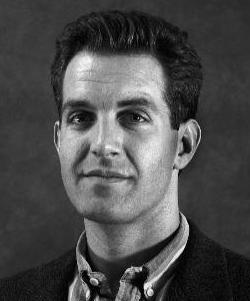 | Alan T. Charlie Johnson, Physics and Astronomy, studies the nanometer-scale transport properties of molecular and super-molecular systems. These systems are of rising interest both from the technological and fundamental points of view. Johnson has made major contributions in the race to create nanotube-based electronics. |
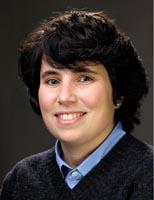 | Cherie Kagan, Electrical and Systems Engineering, has made many scientific contributions to the development of hybrid inorganic/organic transistors, and the rational design and fabrication of molecular electronic structures. |
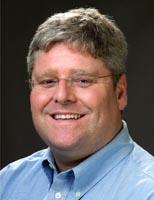 | Chris Murray, Materials Science and Engineering, is a world leader in the field of nanotechnology; his seminal contributions in this area include the creation of artificial atoms (nanocrystals or quantum dots) that self assemble into devices with completely new multi-functionalities. |